Somewhere outside Ashburn, Virginia, there’s a building with no windows and a power bill bigger than a small town’s. Inside it, thousands of identical circuit boards hum in metal racks, cooled by water pipes as thick as your arm. Almost every one of those boards was designed by the same company.
Ask a chatbot to rewrite an email and your request probably lands on that hardware. So does the model reading a chest scan, the fraud check that runs when you tap your card, and whatever picked the next video you watched.
The reason one company sits underneath so much of it isn’t a single lucky product. Nvidia AI hardware won because Nvidia sells three things at once: a very fast chip, the software layer everyone already knows how to write for, and the plumbing that stitches thousands of chips into one machine. Rivals keep matching the first one. The other two are where it gets hard.
Here’s what that grip actually looks like in 2026, who is genuinely closing in, and what any of it means for the prices you pay.

What Nvidia actually sells, and it isn’t just a chip
People talk about Nvidia the way they talk about a car company, as if there’s one product with a model number. There are really three, stacked on top of each other.
The chip
A graphics processor was built to draw video game frames, which means doing a huge pile of small math problems all at once. That turned out to be exactly what training a neural network needs. The gaming business paid for two decades of engineering the AI business then inherited.
The current generation is Blackwell. The next one, Vera Rubin, is due in the second half of 2026 and the numbers are silly: 336 billion transistors, 288 GB of HBM4 memory per GPU, and 22 terabytes per second of memory bandwidth. Nvidia claims it cuts the cost of running a model roughly tenfold compared with Blackwell.
The software almost nobody outside the industry talks about
CUDA is the layer that lets code talk to the chip, and it’s been around since 2007. Nvidia says more than 4 million developers have registered for it and over 40,000 organizations run CUDA accelerated applications.
That head start matters more than any benchmark. Every tutorial, every debugging tool, every optimized library like cuDNN, and every weird performance hack buried inside somebody’s production code assumes Nvidia silicon underneath. The switching cost isn’t the price of the new chip, it’s the six months of rewriting and re testing that come with it.
The plumbing
A serious training run doesn’t use one chip. It uses tens of thousands of them behaving like a single computer, and the networking between them decides whether that actually works or just melts.
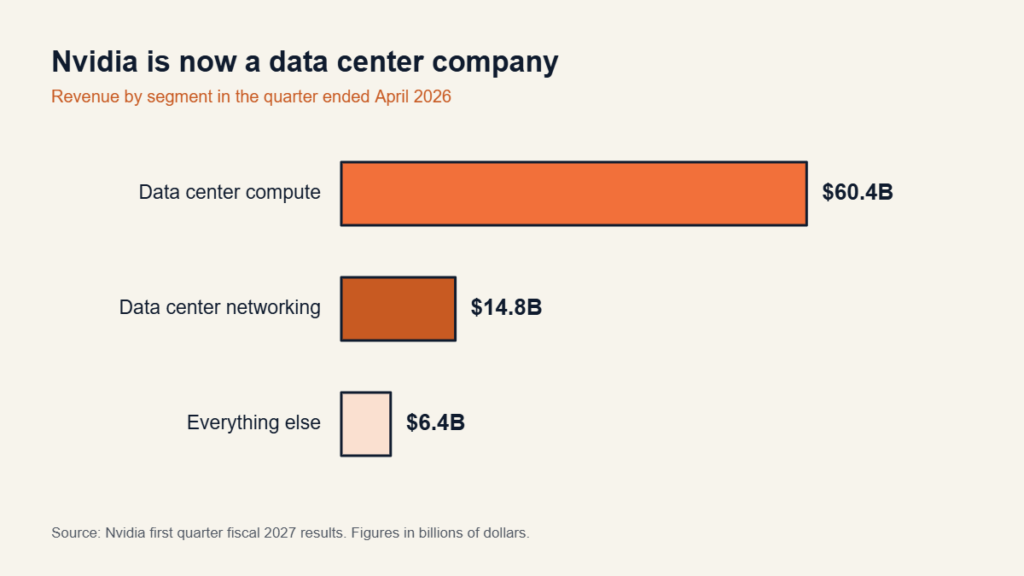
This part is quietly enormous. In the quarter ending April 2026, Nvidia’s data center networking revenue alone was $14.8 billion, up 199% from a year earlier. Buying a rival’s chip often means rebuilding the room around it.
Why Nvidia AI chips ended up with almost the whole market
Estimates of Nvidia’s share of data center AI accelerators land somewhere between 80% and 87%, depending on who’s counting and what they count. IDC put it near 81% for 2026. The spread comes from whether you include custom chips the cloud companies build for themselves, which nobody sells on the open market.
Either way, the shape is the same: one company, most of the market, in a category that barely existed ten years ago. Three things got it there.
Timing. Nvidia was already selling parallel compute to researchers when deep learning took off, so when demand exploded there was a product on the shelf and a software ecosystem around it.
Supply. Nvidia books manufacturing capacity and high bandwidth memory years ahead. When everyone wanted chips at once, the queue was already Nvidia’s.
Pace. Nvidia moved to a roughly annual architecture cadence: Blackwell, then Vera Rubin, then Rubin Ultra in late 2027, then Feynman. A rival aiming at today’s part is aiming at something a generation behind by the time it ships.
The money, in numbers you can actually picture
For the quarter ended 26 April 2026, Nvidia reported record revenue of $81.6 billion, up 85% from a year earlier. Data center accounted for $75.2 billion of that, up 92%. Everything else the company does, gaming cards, automotive, professional visualization, added up to roughly $6.4 billion combined.
Gross margin has been sitting around 75%, which is the part that tells you how little pressure there’s been. About three quarters of every dollar coming in is gross profit, which is a software company’s margin on a physical product.
Full year data center revenue for fiscal 2026 came to $193.7 billion. The stock followed. Nvidia became the first company ever valued above $5 trillion and set a record near $5.5 trillion in May 2026, trading the title of most valuable company in the world back and forth with Apple through the year.
The company has guided to about $91 billion in revenue for the quarter it reports on 26 August 2026. Guidance is a forecast, not a result, and Nvidia has both beaten and disappointed on it before.

Who’s actually catching up
Plenty of companies want this business. They’re taking very different routes at it, and the one making the most noise isn’t the one to watch.
AMD is the closest direct competitor
AMD’s Instinct line is the only real merchant alternative, meaning a chip anyone can buy rather than one a cloud company builds for itself. It’s growing fast. AMD’s data center revenue hit $6.7 billion in the quarter ended June 2026, up 107% from a year earlier and now 58% of the whole company.
The OpenAI agreement signed in late 2025 covers 6 gigawatts of AMD GPUs starting in the second half of 2026, with Helios rack systems and MI455X accelerators heading to customers including Meta and OpenAI. That’s a genuine foothold.
Keep the scale honest, though. AMD’s best data center quarter so far is roughly one twelfth of Nvidia’s.
Google is the more serious threat
Google has been building its own Tensor Processing Units for a decade and is now on the seventh generation, called Ironwood. The difference is that Google isn’t trying to sell you a chip. It’s selling you compute, and every hour rented on a TPU is an hour not rented on a GPU.
The scale of the outside deals is what changed. Google agreed to invest up to $40 billion in Anthropic in an arrangement that includes 5 gigawatts of TPU capacity over five years and access to as many as a million Ironwood chips. Meta signed its own multibillion dollar TPU deal. Demand has been heavy enough that Google’s internal research teams have reportedly had to queue behind paying customers.
The cloud companies building silicon for themselves
Amazon has Trainium. Microsoft has Maia. Meta has MTIA. Broadcom designs a lot of it. None of these are sold as products, and most are aimed at inference rather than training, which is the cheaper and far more repetitive half of the workload.
This is the awkward part of Nvidia’s position: its biggest customers are also its most credible competitors. Every one of them has an obvious reason to want a second source.
China is a wildcard, not a rival yet
US export controls have limited what Nvidia can ship to China since 2022. The company built the H20 to fit the rules, a 2025 export halt was later reversed, and the Commerce Department cleared roughly ten Chinese firms to buy H200 chips with a cap of 75,000 units each.
Then very little happened. Nvidia’s finance chief said in February 2026 that although small volumes had been approved, no revenue had actually been generated from them. Domestic Chinese designs keep filling the gap, which is exactly the outcome Nvidia has warned about for years.

Where the moat is genuinely thinning
The picture above is not permanent, and three things are working against it.
Training and inference are different businesses. Training a frontier model rewards raw speed and the biggest possible cluster, which is Nvidia’s home turf. Serving billions of answers a day rewards cost per answer, power draw, and predictability. Custom chips are much more competitive on that second job, and that job is growing faster.
Second, the software lock is softer than it was. Most people building with AI write in higher level frameworks and never touch CUDA directly, and tools like Triton and MLIR let the same code run reasonably well on several kinds of hardware. Reasonably well is not optimally, and Nvidia still wins on peak performance. But the era of “it only runs on one vendor” is fading.
Third, and least discussed: power and buildings, not chips, are the real bottleneck now. Analysts estimate the majority of hyperscaler capital spending goes to electricity, land, and construction rather than accelerators. You can’t buy your way past a substation.
Most forecasts have Nvidia’s share drifting toward roughly 75% by the end of 2026 and somewhere in the 70% to 80% range by 2028. Worth repeating: those are projections, not measurements.
What all of this means for the prices you pay
If you build with AI, the good news is already visible. Renting an H100 by the hour ranges from about $1.49 to $6.98 across providers, with the market average sitting near $3 for on demand access. That’s roughly a third of what the same chip cost to rent two years ago.
The cause isn’t charity. It’s supply catching up and enough alternatives existing to make a price look negotiable.
If you just use AI, the effect is subtler. Subscription prices for the big assistants haven’t dropped much, but what you get for the money has moved a long way. The cost of a given level of capability keeps falling even when the sticker doesn’t.
The number that should give you pause is the spending behind it. The four biggest cloud companies have guided to somewhere around $700 billion in capital spending for 2026, up from roughly $410 billion in 2025. That money has to earn a return eventually, and the pressure to make it do so will land on pricing, on ads, and on which features stay free. If you want the wider context on how much of this is real adoption, our look at how many businesses actually use AI is a useful counterweight to the headlines.
What to watch over the next year
Vera Rubin shipping on schedule in the second half of 2026 is the first checkpoint. Nvidia’s chief executive told the company’s March 2026 developer conference that Blackwell and Vera Rubin orders through 2027 add up to about $1 trillion, which is a big number to hang on a product that hasn’t shipped yet.
After that, watch the split between training and inference spending, because that’s where share actually moves. Watch whether Google sells TPU capacity to a third and fourth large customer. And watch whether any of the alternative chips show up in a workload that isn’t the buyer’s own.
The wider backdrop is worth knowing too. Our explainer on what reasoning models actually do covers the shift that made inference so expensive, and open weight models closing the gap is the single most plausible way demand for Nvidia AI hardware eventually cools: smaller models, cheaper chips, good enough answers.
Key takeaways
- Nvidia AI dominance rests on three layers, the chip, the CUDA software ecosystem, and the networking, and only the first one is easy to copy.
- Share estimates run from 80% to 87% of data center AI accelerators, with most forecasts expecting a slow drift down rather than a collapse.
- Data center revenue was $75.2 billion in a single quarter, at roughly 75% gross margin.
- AMD is the closest merchant rival, but Google’s TPUs and the cloud companies’ in house chips are the more structural threat.
- Inference, not training, is where competitors are winning, and inference is the faster growing half.
- Renting AI compute has gotten roughly three times cheaper in two years. Consumer prices have moved much less.

Frequently asked questions
What does Nvidia actually make for AI?
Three things. Data center GPUs like Blackwell and the upcoming Vera Rubin, the CUDA software platform that developers write against, and the high speed networking that links thousands of chips into one system. The company also sells complete rack systems, so a customer can buy the whole machine rather than assemble it.
How much of the AI chip market does Nvidia have?
Estimates for 2026 range from about 80% to 87% of data center AI accelerator revenue, with IDC putting it near 81%. The differences come down to whether custom chips built in house by cloud companies are counted. All of these are analyst estimates, not audited figures.
Who is Nvidia’s biggest competitor in AI?
AMD is the closest company selling a comparable chip on the open market, with data center revenue of $6.7 billion in the quarter ended June 2026. But Google’s TPU line is arguably the bigger threat, because Google rents compute directly to large AI companies and doesn’t need to sell a single chip to take the business.
Why can’t companies just buy cheaper chips?
Many are trying. The obstacle is rarely the chip itself. It’s the years of code, tooling, and staff expertise built around CUDA, plus the networking and rack design that a data center is already wired for. Switching is an engineering project, not a purchase order.
Will AI compute get cheaper?
It already has. On demand H100 rental has fallen to roughly a third of its cost two years ago, and Nvidia says Vera Rubin cuts inference cost about tenfold versus Blackwell. Whether that saving reaches consumer subscription prices depends on how hard the cloud companies need to earn back a $700 billion spending year.
The bottom line
Nvidia runs the AI world because it got there first with a chip, then spent twenty years making everything around that chip too useful to abandon. That position is being chipped at from below by cheaper inference silicon and from the side by its own customers, and the erosion looks real but slow.
The more interesting question isn’t whether Nvidia stays on top. It’s whether the enormous bet being placed on all this hardware pays off, because that’s the thing that decides what AI costs the rest of us. If the jargon in any of this tripped you up, our plain English AI glossary unpacks the terms without the sales pitch.
This article is general information, not investment or professional advice. Figures on revenue, market share, pricing, and capital spending were verified on 25 August 2026 and move quickly. Market share numbers are analyst estimates and vary by methodology. Nothing here is a recommendation to buy or sell any security.
Source for Nvidia’s reported financials: NVIDIA Announces Financial Results for First Quarter Fiscal 2027.