Somewhere in your feed right now, someone is promising that an AI storefront will earn you ten thousand dollars a month while you sleep. For a few thousand dollars they’ll sell you the training. For thirty five thousand, they’ll just build the whole thing for you.
The Federal Trade Commission has read those ads too. It sued the people behind them.
Now picture the least glamorous version of the same story. A bookkeeper closes a client’s month in half the time she used to, because a model now does the categorizing and she checks it. She raised her rate. No course, no storefront, no Lamborghini. Same skill, faster.
Both of those get filed under “making money with AI.” Only one of them survives contact with reality.
The honest answer to how to make money using AI in 2026 is duller than the ads and considerably more durable. It also just got easier to prove, because fresh earnings data landed this month that shows exactly who is getting paid and who is quietly getting cheaper.
The 2026 numbers nobody puts in the ads
Upwork published its Future Workforce Index on July 14, 2026. It combines a survey of 2,400 skilled US knowledge workers with the platform’s own contract and earnings data. It’s the clearest public read we have on what AI work actually pays.
The headline sounds like an advertisement for itself. Freelancers doing AI work on Upwork earn 34% more per hour than freelancers who don’t touch it.
Then you read the second number.
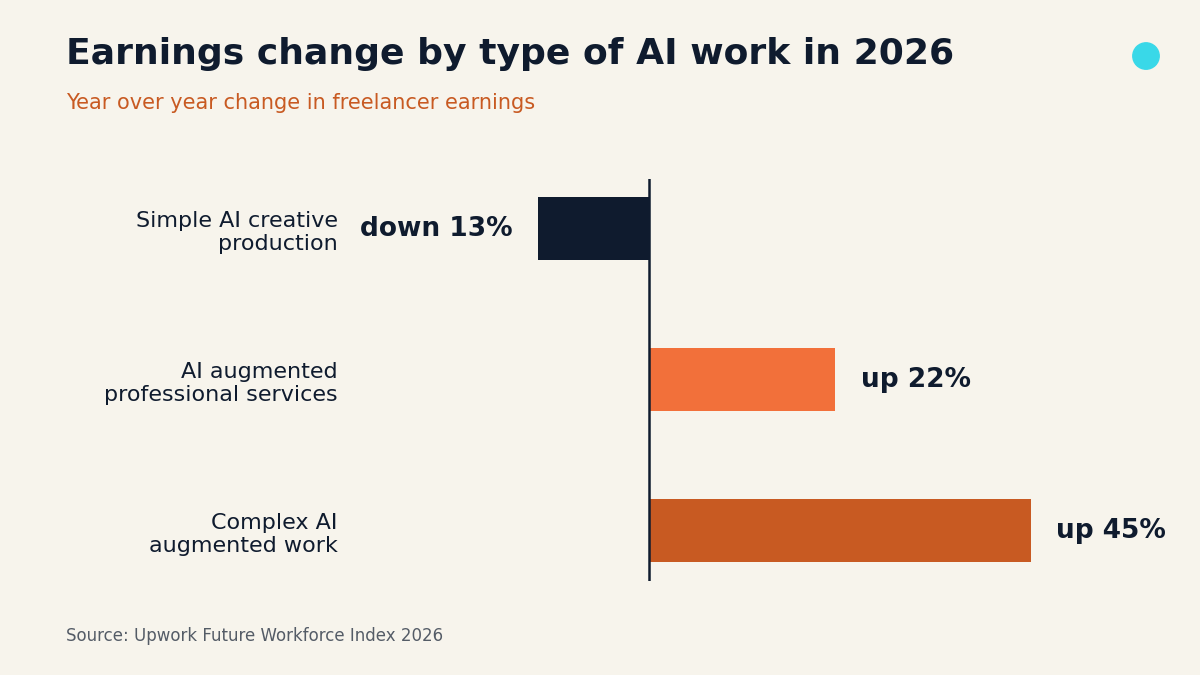
Generative AI and creative production work, which is precisely the thing every “make money with AI” video pushes, grew 90% year over year in contract starts. Earnings per contract fell 13% over the same stretch.
Twice the work. Less money for each piece of it. That’s what commoditization looks like while it’s happening to you.
Complex work went the opposite direction. Freelancers doing harder things with AI saw earnings climb 45% year over year. AI augmented professional services, meaning someone with real domain expertise folding AI into a field they already understood, grew 72% in volume with earnings up 22%.
So the premium is not for using AI. Everybody uses AI. The premium is for judgment.
Stanford economist Nick Bloom, who sits on Upwork’s economic advisory council, framed the wider puzzle well: adoption is everywhere, yet productivity gains are stubbornly hard to see, and in a survey he and colleagues ran of nearly 6,000 executives, most firms reported little measurable impact from AI so far. That gap between how many businesses use AI and how many get value from it is the whole story. The value isn’t spread evenly. It clusters where people apply expertise and business context on top of the tool.
Upwork has a name for the person capturing it: the AI Orchestrator. Someone who connects the tools to a field they know, applies judgment, and is accountable for the outcome.

What people are actually paying for
Upwork’s annual skills report from February 2026 shows where the money moved on the platform. Skills that explicitly reference AI grew 109% year over year. The fastest risers:
- AI video generation and editing, up 329%
- AI integration, up 178%
- AI data annotation and labeling, up 154%
- AI image generation and editing, up 95%
- AI chatbot development, up 71%
Notice what none of those are. None of them is “prompt a chatbot.” Every one is a job where somebody hands you a business problem and expects a working thing back.
One more figure worth sitting with: 77% of business leaders told Upwork that AI is increasing their need for specialized, fractional talent rather than traditional full time roles. Companies are buying expertise in slices now. That’s the opening, and it’s a wide one.

How to make money using AI in 2026: six realistic ways
Every honest answer to how to make money using AI starts in the same place: pick something a person already pays for. These are roughly ordered by how fast you can start, not by how much they pay.
1. Charge more for the skill you already have
This is the boring one, and it’s the one the data keeps pointing at. Take the work you already get paid for, use AI on the slow parts, and either take more clients or raise your rate because the turnaround got better.
The bookkeeper from the intro is the whole model. Her edge isn’t the model. It’s that she knows when the model is wrong, and a client is paying for exactly that.
Time to first dollar: you already have clients. Start Monday.
2. Wire AI into someone else’s business
AI integration demand rose 178% on Upwork. This is the work of connecting a model to a company’s actual systems: their inbox, their CRM, their support queue, their spreadsheets.
Most small businesses have now bought a subscription and discovered that a subscription doesn’t do anything by itself. Somebody has to build the thing that does the work, then stay around when it breaks. That somebody gets paid well because the alternative is a hire.
You need to be technical, though not necessarily a career engineer. If you can read documentation and debug patiently, you’re in range, and the AI tools developers actually use are a reasonable place to start.
3. Produce video and images as a service
AI video generation and editing was the single fastest growing skill in Upwork’s whole 2026 report at 329%. Real demand, no argument.
But this is the exact category where per contract earnings dropped 13%. Volume is exploding and prices are sagging, at the same time, for the same reason: the barrier to entry is a free trial.
If you go here, don’t sell “AI videos.” Sell product demos for medical device companies, or ad variants for a specific ecommerce niche you understand. Generic output is where the price falls fastest.
4. Label and evaluate AI training data
AI data annotation and labeling grew 154%. Labs need humans to judge model outputs, and increasingly they want humans with credentials: nurses rating medical answers, lawyers rating legal ones, developers grading code.
Be clear eyed about it. Generic labeling pays like generic labeling. The version that pays is the one where your professional background is the product.
5. Build a small tool and sell it
Building software got dramatically cheaper, which is why everyone tells you to build an app. They skip the part where distribution didn’t get cheaper at all. Shipping was never the hard bit.
This can absolutely work, and it works best when you already sit inside an industry, feel a specific irritation daily, and know fifty people with the same one. It fails when it’s a generic wrapper hunting a generic audience.
Treat it as a long shot with a long runway, not a plan for rent money.
6. Teach it to people who don’t have time to learn it
Somebody has to run the training when a 40 person firm decides everyone should use AI properly. Right now that somebody is often whoever raised their hand.
The honest caveat: this niche is loud with people teaching a thing they’ve never done for money. If you’ve actually done the work, say so, and let the difference speak. If you haven’t, do it first.
The platforms already closed the “just publish more” loophole
A lot of AI income advice still assumes you can point a model at a platform and let volume do the rest. That window is closing, and the platforms are the ones closing it.
On July 15, 2025, YouTube renamed its repetitious content policy to inauthentic content and spelled out that mass produced and templated videos are ineligible for monetization. Slideshows with no commentary, videos built from one template and repeated at scale, readings of text you didn’t write. And the policy applies to your channel as a whole, so a batch of cheap uploads can cost you monetization on everything.
Amazon moved earlier. Kindle Direct Publishing requires you to disclose AI generated text, images, and translations, and caps new title uploads at three per day per account, a limit it confirmed to the Authors Guild specifically to throttle mass publishing.
The pattern is consistent across platforms. Anything you can produce with no effort, thousands of other people are also producing with no effort, and the platforms have started taxing it. Effort is the moat now.

The AI money scams worth walking away from
In September 2024 the FTC launched Operation AI Comply, a sweep against companies using AI claims to dress up ordinary fraud. The case files are a useful education.
Ascend Ecom promised “cutting edge” AI tools would generate thousands a month in passive income from online storefronts. The FTC alleges it took consumers for at least $25 million. A court halted it and put it under a receiver.
FBA Machine, previously Passive Scaling, promised guaranteed income through AI powered storefronts and cited clients supposedly clearing $100,000 a month in profit. The FTC puts consumer losses above $15.9 million.
Ecommerce Empire Builders sold an “AI powered Ecommerce Empire” through training that ran near $2,000, or a done for you storefront for as much as $35,000, advertising $10,000 months it had no evidence for.
The tells repeat across all three. Passive income. Guaranteed returns. AI as the magic ingredient rather than a tool. A large payment before you’ve earned a dollar. Testimonials with numbers and no verification.
Here’s the cleanest filter. If someone has a genuine machine that prints money, the machine is worth more than your $35,000. Nobody sells that. They keep it.
A realistic first 90 days
No income promises here, because anybody making one is guessing. But there’s a sequence that beats drifting.
Weeks 1 to 4. Pick one thing you already know how to do that somebody pays for. Not a trend. A thing you know. Then find the slow part of it and put AI on that part only.
Weeks 5 to 8. Do it for one real client, ideally someone who already trusts you, at a rate that isn’t free. Write down what broke and what you had to fix by hand. That list is your expertise becoming visible.
Weeks 9 to 12. Turn that into an offer with a name and a price. Show the result. Nobody buys “I use AI.” They buy “your month closes in three days instead of eight.”
If you want a single rule for how to make money using AI without burning a year on it: sell the outcome, never the tool. The tool is free next year. The judgment isn’t.
Key takeaways
- AI work pays a real premium, about 34% more per hour on Upwork, but the premium follows judgment, not tool use.
- Simple AI output is already deflating. Generative creative production grew 90% in contract starts while earnings per contract fell 13%.
- Complex AI augmented work moved the other way, up 45% in earnings, with AI augmented professional services up 72% in volume.
- Platforms are actively closing volume plays. YouTube demonetizes mass produced content at the channel level and Amazon caps uploads at three titles a day.
- The AI passive income pitch is a well documented fraud pattern. Two FTC cases alone account for more than $40 million in alleged consumer losses.
- The most reliable path is the least exciting one: the skill you already have, done faster, sold as an outcome.
Frequently asked questions
Can you really make money with AI in 2026?
Yes, and the data backs it. Upwork freelancers doing AI work earn 34% more per hour than those who don’t. The catch is that the earnings are concentrated in complex work where someone brings domain expertise, not in generic AI output, which is getting cheaper as more people supply it.
What is the easiest way to make money using AI?
Applying it to work you already get paid for. You skip finding clients, learning an industry, and building an audience, which is where most attempts die. A freelancer, tradesperson, or consultant who uses AI to cut turnaround can raise rates or take more work without any of that overhead.
How much can a beginner make with AI?
Nobody credible can tell you, and the specific monthly figures floating around online mostly trace back to people selling courses. What the platform data shows is the direction of travel: AI skills grew 109% year over year in demand, and 77% of business leaders say they need more specialized fractional talent. Your earnings depend on the skill you bring, not the model.
Is AI passive income real?
Treat the phrase itself as a warning label. It’s the exact language the FTC targeted in Operation AI Comply, where AI storefront schemes promising passive income cost consumers tens of millions. Real income from AI looks like work: a client, a deliverable, an invoice, and someone answering when it breaks.
Do I need to be technical?
For AI integration work, somewhat. For everything else, no. The highest earning category in Upwork’s 2026 data is domain experts folding AI into fields they already knew, which means the accountant, the paralegal, and the marketer have a real advantage over the generalist who only knows the tools.
This article is general information, not professional, financial, or legal advice. Earnings figures come from Upwork’s published research and FTC enforcement filings, verified in July 2026, and describe other people’s results rather than predicting yours. Platform policies change often, so check the current terms before building anything on top of them.