Open any SEO newsletter this year and you’ll get pitched a dozen tools that all promise the same thing: type a keyword, let the AI work, watch your rankings climb. Then you sign up, land on a dashboard packed with credits and toolkits and score meters, and you’re less sure what to do than before you started. The tools are real and some are genuinely good. The marketing around them is mostly noise.
So this is the plain version. I’ve sorted the best AI tools for SEO by the job you’re actually trying to get done, with the real 2026 prices and the honest catch on each one. No single tool wins every category, and the cheapest useful option on this list costs nothing at all.
How I picked these
Three things mattered. First, the tool has to do a specific SEO job well, not just wave the word “AI” around. Second, the pricing has to make sense for a normal site, not only a big agency. Third, it has to earn its place next to the free option you already have. Prices below are the public 2026 rates at the time of writing, and SEO tools change their plans often, so check the current number before you buy.
One thing worth saying up front: no tool ranks your site for you. These speed up the work and point you at better decisions. The judgment, the writing, and the actual publishing stay yours.
Best AI tools for SEO at a glance
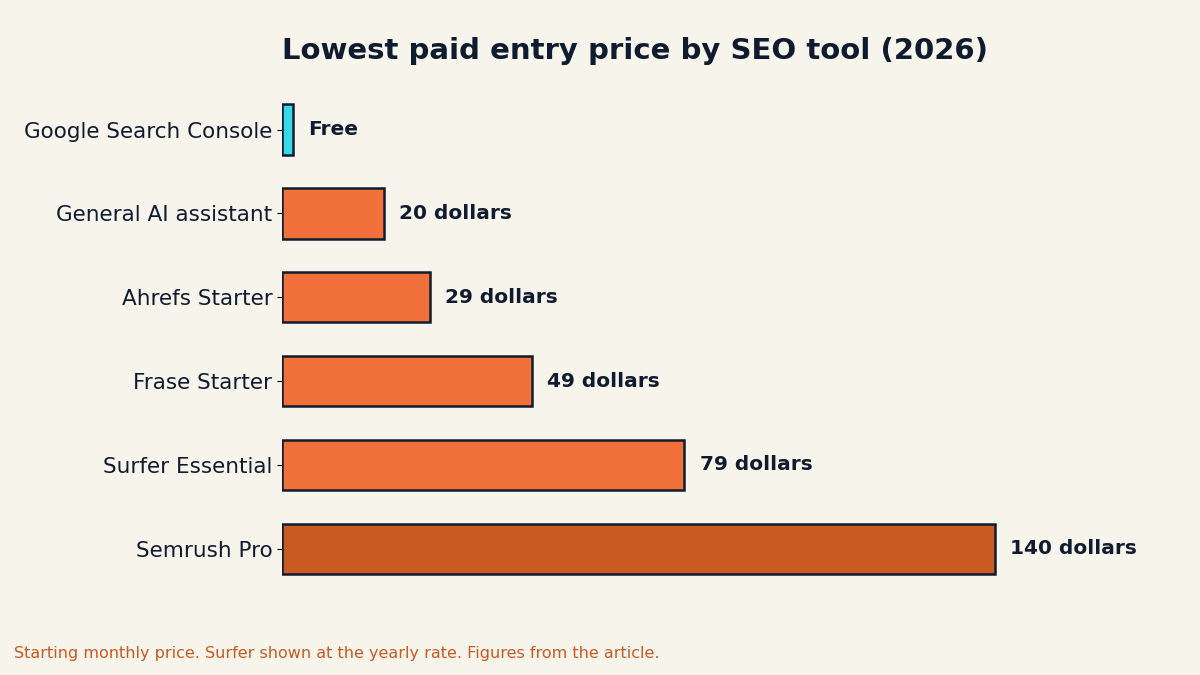
| Tool | Best for | Free option | Lowest paid plan |
|---|---|---|---|
| Google Search Console | Real data on what you already rank for | Yes, fully free | Free |
| Semrush | One platform for research and tracking | Limited free account | Pro, about 140 dollars a month |
| Ahrefs | Backlinks and site audits | Free Webmaster Tools | Starter, 29 dollars a month |
| Surfer SEO | Optimizing a draft to match what ranks | No, trial only | Essential, 79 dollars a month yearly |
| Frase | Fast content briefs on a budget | 7 day trial | Starter, 49 dollars a month |
| A general AI assistant | Outlines, clustering, meta, grunt work | Yes, capable free tiers | About 20 dollars a month |

The tools, reviewed
Here’s each of the best AI tools for SEO on the list, what it’s genuinely good at, and the catch that the sales page won’t lead with.
Google Search Console, the free one everyone skips
Before you pay for anything, use the tool Google gives you. Google Search Console shows the exact queries bringing people to your pages, where you rank for each, your click through rate, and which pages Google has indexed. It’s the only source here pulling from Google’s own data instead of an estimate.
The AI angle is quieter but real. When you spot a page ranking on the second page for a keyword with steady impressions, that’s your highest value target, and you can hand that query straight to a writing tool to improve the page. Search Console tells you where the opportunity is. The paid tools help you act on it faster.
Best for: every single site, no exceptions. Verdict: start here, learn to read the Performance report, and you’ll waste less money on the tools below. [Matt: add your hands on screenshot/verdict here before publishing]
Semrush, the do everything platform
Semrush is the closest thing to one login that covers the whole job: keyword research, competitor teardowns, rank tracking, site audits, backlink data, and content ideas. In 2026 it also added an AI Visibility Toolkit that tracks whether your brand shows up in AI answers, which is a new thing worth watching.
The catch is the price. The Pro plan runs about 140 dollars a month, and Guru, the tier most teams actually want for historical data and more tracking, is about 250 dollars a month. Extra user seats cost more on top. It’s powerful, but it’s the most expensive habit on this list.
Best for: one person or a small team who wants everything in a single tool and will use most of it. Verdict: excellent if you’ll live in it daily, overkill if you won’t. [Matt: add your hands on screenshot/verdict here before publishing]
Ahrefs, the backlink and audit specialist
If your main questions are “who links to my competitors” and “what’s broken on my site,” Ahrefs is the sharpest answer. Its backlink index is one of the largest anywhere, and its site audit is a favorite for finding technical problems that quietly hold a site back.
The pricing shifted in a big way this year. Ahrefs added a 29 dollar a month Starter plan in early 2026, which cut the entry price by about 70 percent and opened basic keyword research and audits to smaller sites. The full Lite plan is 129 dollars a month, or 99 a month billed yearly. There’s no free trial, but a free Webmaster Tools account lets you audit a site you own.
Best for: link building, competitor research, and technical audits. Verdict: the Starter plan finally makes Ahrefs realistic for a solo blog. [Matt: add your hands on screenshot/verdict here before publishing]
Surfer SEO, for making a draft actually rank
Surfer does one job and does it well. You paste a draft, it compares your page against the ones already ranking for your keyword, and it tells you what to add: terms you missed, a word count target, headings to include. For writers who guess at what “good enough” looks like, it turns that guess into a checklist.
The Essential plan is 99 dollars a month, or 79 a month if you pay yearly, and it covers 30 content editor articles and 100 page audits a month. One thing to watch: on monthly billing, unused credits expire, so Surfer only pays off if you publish steadily. Its separate AI Tracker, which watches whether you show up in AI search, is an extra 95 dollars a month.
Best for: content teams publishing several articles a month who want data behind each one. Verdict: worth it if you write a lot, wasteful if you publish once in a while. [Matt: add your hands on screenshot/verdict here before publishing]
Frase, the budget brief builder
Frase sits where Surfer does, in content optimization, but aims at smaller budgets. It reads the top results for your keyword and builds a research brief and outline in a couple of minutes, which is the slow part of writing for most people. It also scores your draft against competitors like Surfer does.
The Starter plan is 49 dollars a month, or 39 a month yearly, and covers 10 articles. There’s a 7 day trial but no permanent free plan. If you’re producing a handful of well researched posts a month rather than dozens, Frase gets you most of Surfer’s value for roughly half the money.
Best for: freelancers and small blogs that want briefs fast without a big monthly bill. Verdict: the value pick for lighter publishers. [Matt: add your hands on screenshot/verdict here before publishing]
A general AI assistant, the cheap flexible helper
You don’t need a dedicated SEO tool for a lot of everyday SEO work. A general assistant like ChatGPT, Gemini, or Claude will cluster a messy keyword list into topics, draft an outline, write a first pass at title tags and meta descriptions, and turn a Search Console export into plain language. Capable free tiers exist, and the paid plans run about 20 dollars a month.
The limit is that a general model doesn’t have live ranking data and will happily invent a statistic or a source. So use it for structure and drafts, then check the facts and the keywords against a real tool. Treat it as a fast intern, not an authority. If content is a big part of your work, our guides to the best AI tools for marketers and how to use AI in marketing pair well with this stack.
Best for: outlines, clustering, meta drafts, and cleaning up data on any budget. Verdict: the best value on the list, as long as you fact check what it gives you.

The new job: showing up in AI answers
Here’s the shift that changed SEO this year. A growing share of Google searches now show an AI Overview at the top, and estimates of how common they are range widely, from roughly a quarter of queries in one 2026 benchmark to more than half in another, depending on how it’s measured. Either way, it’s a lot, and it pushes the classic blue links down the page.
That matters for a simple reason. When your page gets cited inside an AI answer, it can earn far more clicks per view than an uncited page on the same query. So a new job has appeared next to normal ranking: getting mentioned in AI results, sometimes called GEO or answer engine optimization. Most of the paid tools above now sell an add on that tracks it, like Semrush’s AI Visibility Toolkit, Surfer’s AI Tracker, or Ahrefs Brand Radar.
You don’t need to buy one yet. The habits that get you cited are the old reliable ones: answer the question clearly and early, back claims with real numbers and sources, and structure the page so a machine can lift a clean answer out of it. Do that well and you’re already most of the way there.
How to build a stack by budget
You don’t need all six tools. Match the stack to where you actually are.
On a zero dollar budget: Google Search Console plus a free AI assistant. Console tells you what’s working and where you’re close, the assistant helps you write and organize. This combination is more than enough to grow a new blog for months.
On about 50 to 100 dollars a month: add one content tool, either Frase for lighter output or Surfer if you publish often, and keep the free assistant for outlines. This is the sweet spot for most solo sites and small teams.
On a few hundred a month: add Ahrefs for backlinks and audits, or step up to Semrush if you want research and content in one place. At this level you’re running a real content operation, and the tools start paying for themselves.
The most common mistake is buying the biggest plan first. Start free, add one paid tool when you feel a specific pain, and let your workload pull you up the ladder instead of pushing yourself up it.

Where these tools still fall short
Every one of these can point you wrong if you follow it blindly. Content scores reward pages that match the top results, which nudges everyone toward the same safe, samey article, and Google has spent years trying to reward the opposite. Keyword difficulty numbers are estimates, not promises. And an AI writing feature will produce a confident draft that’s thin, generic, or quietly wrong if you publish it without editing.
The pattern holds across all of them. The tools are great at the mechanical parts of SEO, the research, the checklists, the audits. They’re weak at the parts that actually win, which are having something useful to say and saying it in a way only you could. Keep that work for yourself.
Key takeaways
The best AI tools for SEO in 2026 each solve one job, so pick by the job, not the hype. Google Search Console is free and belongs on every site. Semrush is the all in one for teams who’ll use it, Ahrefs owns backlinks and audits with a new 29 dollar entry point, Surfer and Frase optimize your drafts at different budgets, and a general AI assistant covers the everyday grunt work cheaply. Getting cited in AI answers is the new job, but the old habits of clear, well sourced writing still earn it. Start free, add one paid tool at a time, and never let a score replace your own judgment.

Frequently asked questions
What is the best AI tool for SEO for beginners?
Start with Google Search Console, which is free, plus a free AI assistant for outlines and meta descriptions. That combination teaches you what actually moves your rankings before you spend a cent. Add a paid content tool like Frase once you’re publishing regularly.
Can AI tools get my site ranked on their own?
No. These tools speed up research, optimization, and audits, but rankings come from useful pages, real links, and time. Treat the tool as an assistant that handles the busywork, and keep the writing and the final decisions with a human.
Are free AI SEO tools good enough?
For a new or small site, often yes. Google Search Console and a free AI assistant cover the essentials, and Ahrefs Webmaster Tools audits a site you own at no cost. You’ll outgrow the free tier eventually, but there’s no reason to pay before you feel the limit.
Do I need a tool for AI search and AI Overviews?
Not yet, for most sites. The add ons that track your presence in AI answers are useful for brands that live or die by search, but the way to get cited is the same clear, well sourced, well structured writing that good SEO already rewards. Focus there first.
This article is for general information only and is not professional, legal, or financial advice. Tool prices and features change often, so confirm the current details on each provider’s site before you buy.